This summer I attended a writing workshop hosted by the brilliant book editor, Brian Henry, on how to write a bestseller. I was excited to attend the workshop and be able to rub shoulders with the likes of Kelley Armstrong (author of the Otherworld Series) and, as usual, my imagination got away from me in the days leading up to it.
You know what I’m talking about.
While instructing us in the do’s and don’ts of making it to the big times, our eyes would meet. She would feel compelled to ask me what my current novel was about, and then, after I ever-so-eloquently pitched my story, she would request we become BFFs immediately and later that day we would be discussing the movie rights of my yet-to-be published novel as we sipped latte’s under a patio umbrella.

Yeah, so that didn’t happen. But I did shake her hand.
The workshop, itself, was pretty great. Kelley spoke in detail about characters, central goals, minor goals, conflict, POV and the emotion in our fiction. She was easy to understand, and there was a simplicity to what she was saying that helped me re-align my story in order to provide complexity, depth, and of course, action, action, action.
There was also a lot of obvious stuff thrown around. Things like, “you need to write a good story,” and you need to “stand out,” and have a “fresh voice,” that is different and compelling. We’ve all heard that before, right? But instead of wanting to slap her, I found that Kelley made it work. She backed up those statements with the “how” that most people leave out.
The most important piece of advice that I took home was that success has to be hard-fought. Another obvious humdinger. But the not so obvious part was that the fight of my characters for success needed to mirror my own. I had to work hard to bring my novel to the publishing market, and my characters had to work just as hard to bring success to the story. It was an inspired epiphany of layers that made me drive home in a mind-blown daze. If I want readers to spend their time in my world, I need to fight to give them something worthy of their time.
Somewhere about half-way during the workshop, we stopped for a short writing prompt. We got our notebooks out and had 20 minutes to crank out a short story based on a collaboration of prompts. Quite honestly, I’d never written a short story under pressure before and I was a bit panicked at the prospect. Everyone else seemed to be scribbling away and I was just sitting there like some gloss-eyed fool. But I persevered, and a couple of months later, that short story went on to win the Eden Mills Fringe contest. A short story that I’ve been invited to read at the Eden Mills Writers’ Festival next weekend on September 13th. That never would have happened without Brian Henry, that workshop, or the inspiration from Kelley.

Keep writing, keep editing, and think about taking a workshop or two. It’s worth the investment.












 UberScribbler
Self-sabotage in the words of… Phillip?
You know when you’re sitting around in the car waiting for someone, and you’re so bored that you start going through your Facebook newsfeed on your phone—clicking on all the posts that you didn’t give a frac about earlier in the day? Yeah, well that was me yesterday. Sitting alone in the dark, playing Russian roulette with strangers posts.
First, let me clarify, I don’t normally click posts (even in extreme boredom) that look sketchy or are likely to piss me off. So, here was the link to an Upworthy video, titled: Homosexuality Is An Annoying Thing Someone Invented, So This Group Of Americans Is Un-Inventing It and I’m thinking—I don’t even want to know what that’s about. So instead, I skim the comments, ’cause there’s plenty of those and I can be a bit of a comment whore. I mean, who isn’t, right? I’m pretty sure that’s what makes Tumblr an up-and-coming social juggernaut.
I should also clarify, I did not actually watch the video that bunched up all the knickers of the commenters, I guess I wasn’t that bored. Or maybe I just didn’t care enough. (Maybe you do, so go find it here.) Sometimes it’s just fun to start with nothing and then build the story backwards from the comments. You have to have a fairly good understanding of comment player ratios though. I mean, how many of the educated versus uneducated, the douchebags versus the do-gooders and that sort of thing. (I affectionately refer to this as the science of Trollology.) It puts comments in perspective.
While I may be a comment voyeur—somewhere in the forever alone statistics, “Phillip” is a comment activist. A rare contributor. (Since I have no comprehension of Bulgarian—written or otherwise—Phillip is what I’m calling him. )
Any comment that starts with “Woah there!” on its own line… has my attention. I mean, Woah where? What’s happening? Who pissed you off? Tell me everything. I must know. (Because I’m sitting here in my truck with nothing better to do at the moment.)
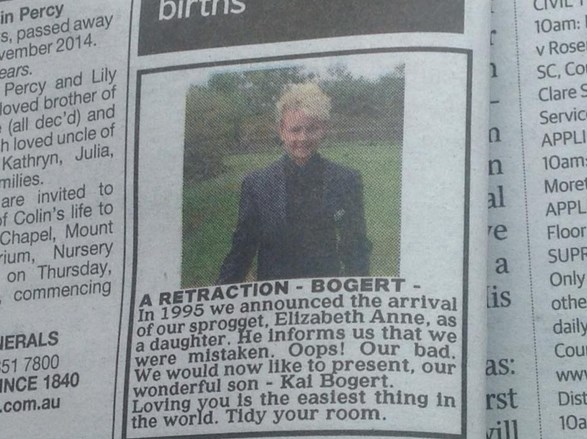
And while I silently expected to be entertained with emotional trite—Phillip had me. He understood the basic underlying issue in all LGBTQ discussion. (In fact, most people issues, full stop.) He’s identified the chipped corner on the building blocks of all we know of each other today. The fact that we did this to ourselves. No, really. If we want to make things better, we need to stop pointing out differences—primarily our own. Just stop. Don’t be different. Just… BE.
Here’s his excerpt, and just for the sake of his own protection and anonymity (on the internet? Pishaw! Well, at least on this blog.) I obstructed part of his name.
What do you think? Does that make sense to you? Does it make you angry? Serious? Are you emotionless? I’d really like to know. (I’d also like to update my pie chart with current stats.)
Share this:
Leave a comment
Filed under Awesome, Social Media
Tagged as bias, comments, gender, gender equality, homosexual, labels, LGBT, LGBTQ, memes, upworthy