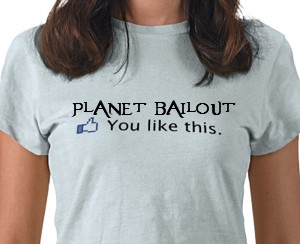
Is it even possible to initiate a planet bailout?
The gap between the pressure on our natural resources and governments’ response to the deterioration is widening. Never has the world faced a more pressing crisis than the current loss of biodiversity, which affects every living thing on the planet. Shouldn’t that be scary?
This morning I was minding my own business–catching up on some internet reading–and slowly seducing my first cup of coffee when I stumbled across an interview with Bill Jackson, the IUCN Deputy Director General.
“Twenty-one percent of all known mammals, 30 percent of all known amphibians,12 percent of all known birds, 35 percent of conifers and cycads, 17 percent of sharks and 27 percent of reef-building corals assessed for the IUCN Red List of Threatened Species™ are threatened with extinction. If the world made equivalent losses in share prices there would be a rapid response and widespread panic, as we saw during the recent economic crisis. The loss of biodiversity, crucial to life on earth, has, in comparison, produced little response. By ignoring the urgent need for action we stand to pay a much higher price in the long-term than the world can afford.”
Um, yeah, well when you say it like that… it makes me feel bad. I happen to like mammals–some of my favourite people are mammals. Do we really care about our standard of living more than we do about the health of a species that we may never even see? Is it too much out of sight–out of mind? Is it still a deeply held view that protecting the enviroment constitutes a net expense to our economy? Are we so concerned with our own welfare that we consider saving money rather than spending it on protecting our enviroment? Is that not an investment–rather than consumption? Clearly, I need to speak to the oxymoron in charge.
I don’t carry the same yardstick as our global leaders to measure my prosperity. So, tell me what to do Bill. I’ve put down my coffee and I’m listening.
~uberscribbler


 When the chips are down, asking for help can be risky business. There are some folks, however, who are all too comfortable leaning on others; they are altogether an entirely different story. For must of us though, asking for help is like making a deal with the devil. It means admitting that we are not the rugged, problem solving individuals that society expects us to be. Once we ask for it, we surrender our control; we become weak, needy and incompetent. We have a tendency to act as though it’s a complete and total character deficiency, as if we are letting our guards down to somehow invite hurt and embarrassment in. God forbid our request for help is used against us. We worry about what will be expected of us in return. What price must we pay for this help since modern civilization has adopted a reciprocal relationship system (tit-for-tat) so that we don’t feel indebted to those who answered our call? There is also the fear that we may present our request to the wrong individual and then suffer with a lifelong hovering and patronizing relationship.


 UberScribbler